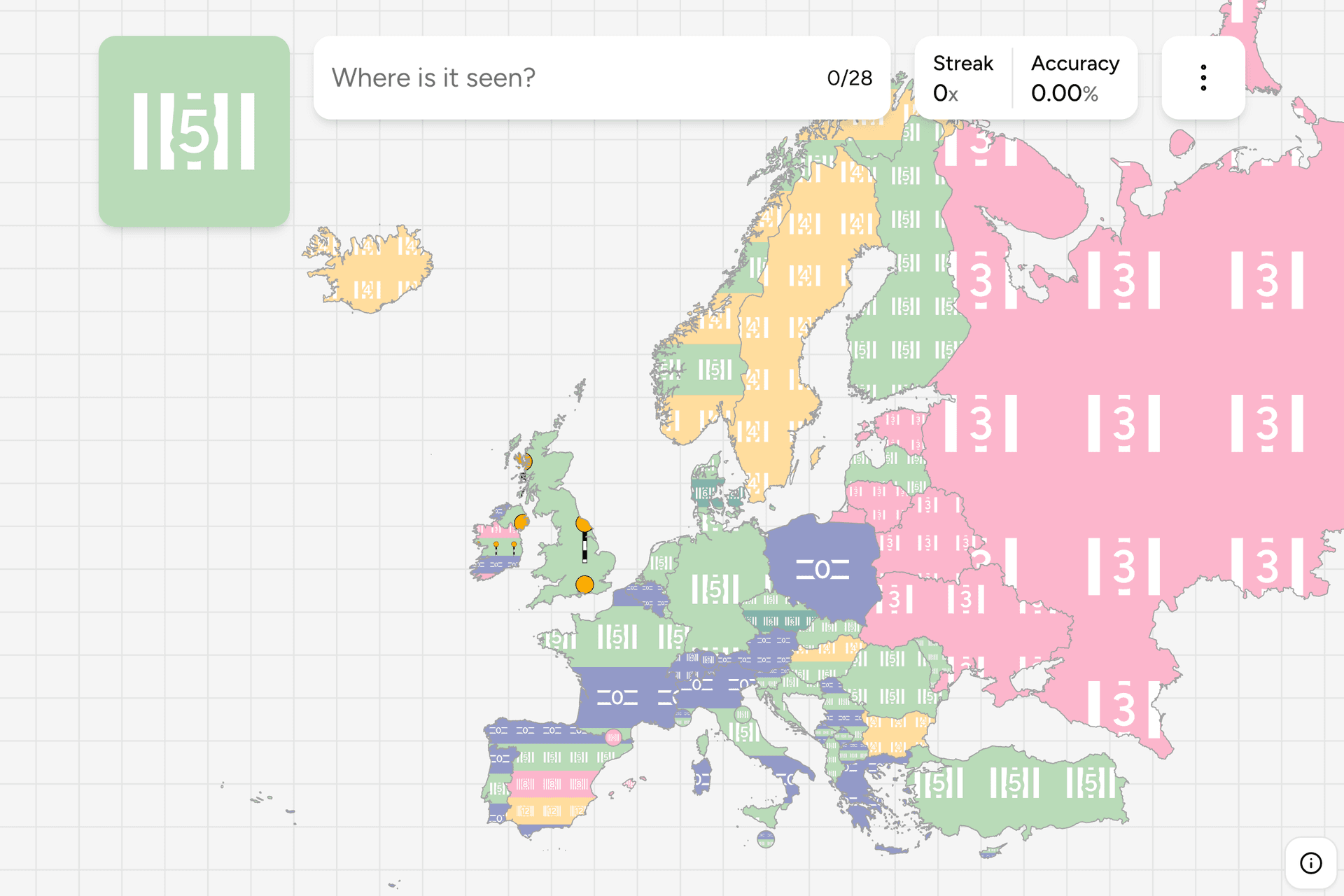
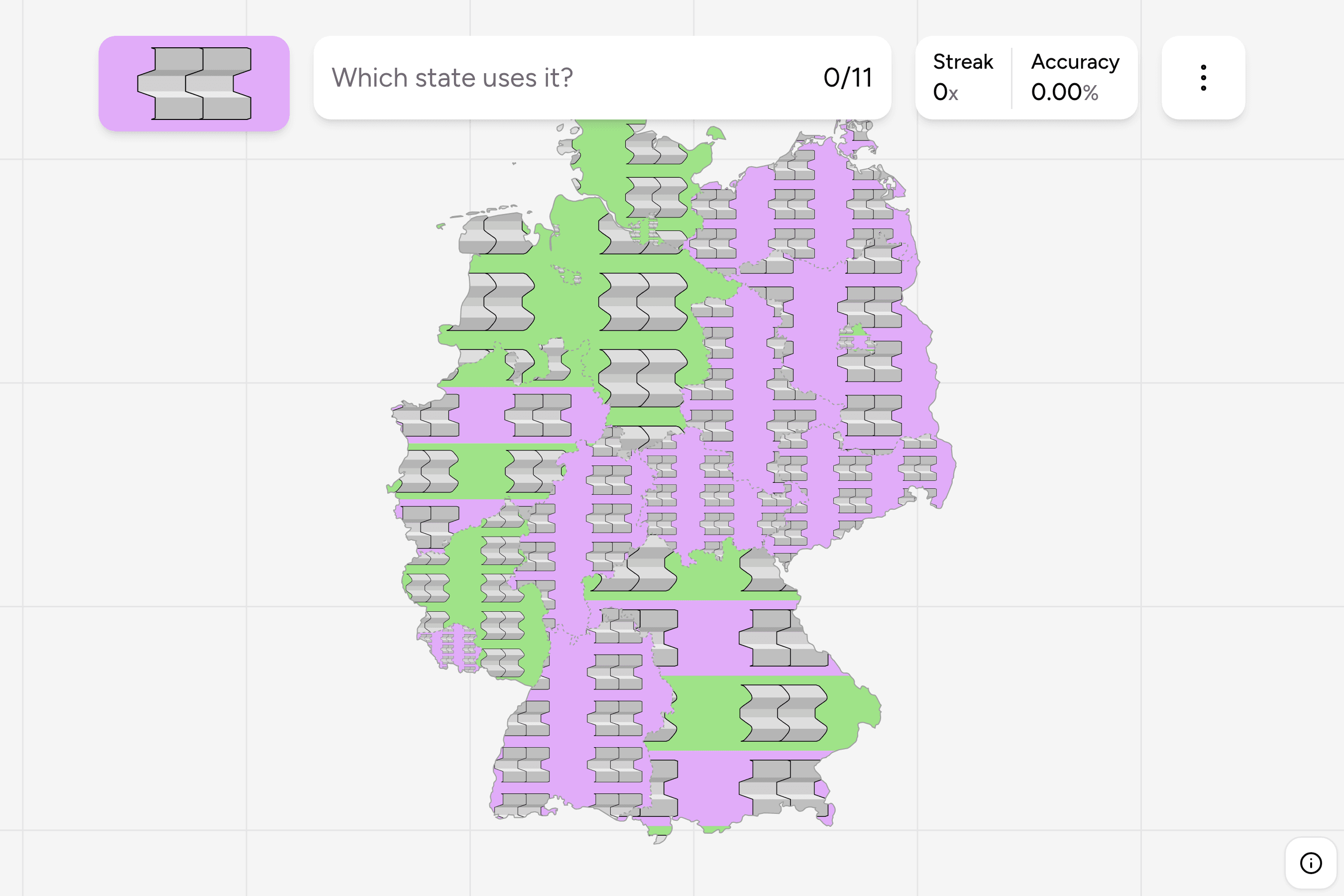
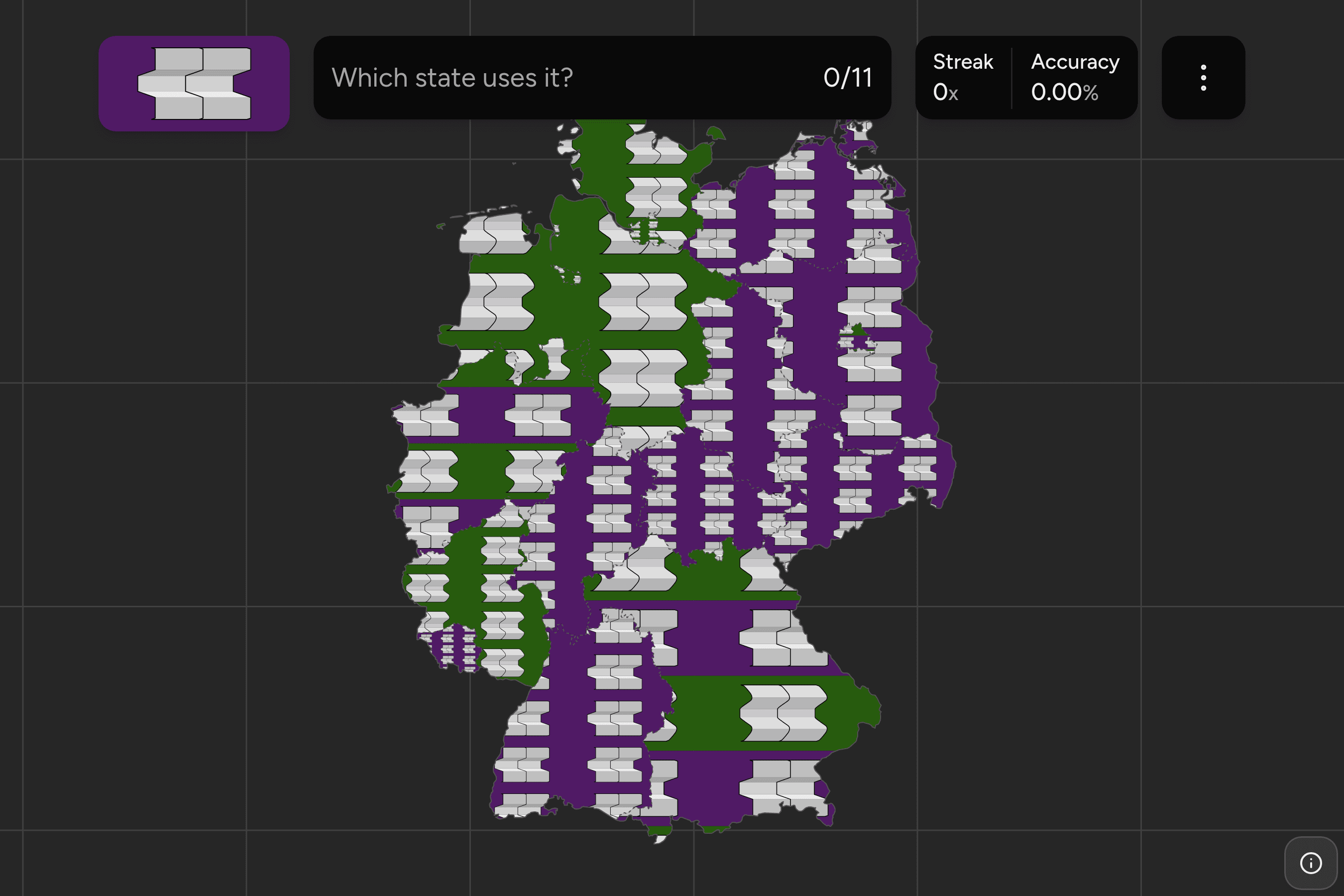
Almost every European country marks a pedestrian crossing with the same blue
sign, and almost every one of them draws a different crossing on it. The stripes
under the walking figure are countable, they are set by a national standard, and
they sit on a sign that is bolted to a pole at eye level next to the road. Count
them and most of the continent falls away. This page is the full list, and the
game drills it.
The sign that warns of, or points out, a place to cross: in most of Europe a
blue square with a white triangle inside it, a figure walking, and under the
figure the crossing itself. It goes by the local name of the crossing, which is
also what people search for (Zebrastreifen in German, passage piéton in
French, paso de cebra in Spanish), and it is put up wherever there is a
crossing to point at, which means towns, villages, school gates and the mouths
of junctions.
What makes it a clue is that nobody agreed on the crossing in the picture. The
sign shape is standardised across most of the continent and the drawing inside
it is not, so two countries either side of a border can run the same blue square
with a different number of stripes on it. The count is national, it changes
about as often as a road standard does, which is to say hardly ever, and it is
legible from further away than a name on a shopfront.
One corner of Europe marks the crossing instead of signing it. There the stripes
on the road are flanked by a beacon, an amber globe on a black and white banded
pole standing at each end, and there is no counted crossing on a blue square to
read. The game asks about the beacon as one more design, because in a round it
does the same job.
How to count one
The count is the whole clue, so the order is: find a sign you can actually read,
then count.
Get square to it. A sign photographed at an angle loses its outermost
stripes to perspective before it loses anything else, and the outermost
stripe is exactly the one that separates two answers. Drive until the sign
faces you.
Count under the figure, not around it. The walking figure stands on the
crossing and its legs cover part of it. The stripes continue behind them, and
a leg is not a stripe.
Count the stripes, not the gaps. An even count and an odd count belong to
different sets of countries, so an off-by-one here is not a near miss, it is
a different continent's worth of candidates.
Treat zero as an answer. A crossing drawn as plain lines with no stripes
at all is a real design and a common one, not a sign you failed to read.
Then the failure modes. A sign too far away to count is worth nothing at all, so
resist reading a blur as the count you were hoping for: five is the safe guess
and the safe guess is the one that loses rounds. Old signs survive next to new
ones, roadworks bring in temporary versions, and a sign that has faded to a pale
blue rectangle is telling you about the weather and not the country.
Every design in the game
Read it as a lookup table: find the count, and the countries next to it are the
answer. Note how uneven the groups are: one count covers more than half the
countries here while several cover two or one, which is what makes the rare
counts the ones to learn first.
Every design in the game, against the countries it is seen in. Generated from the game's own data, so it always matches what the game asks.
Count
Where you see it
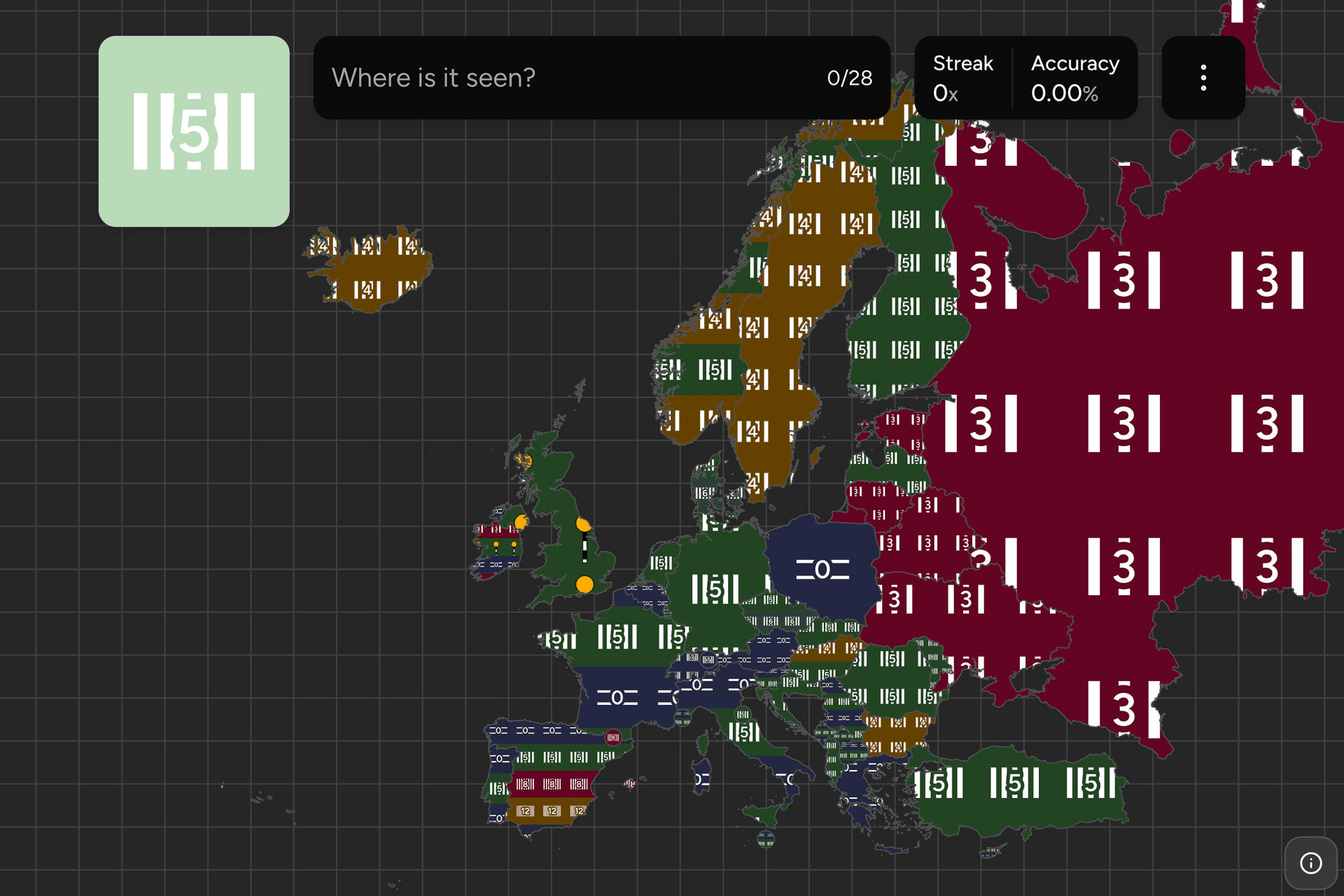
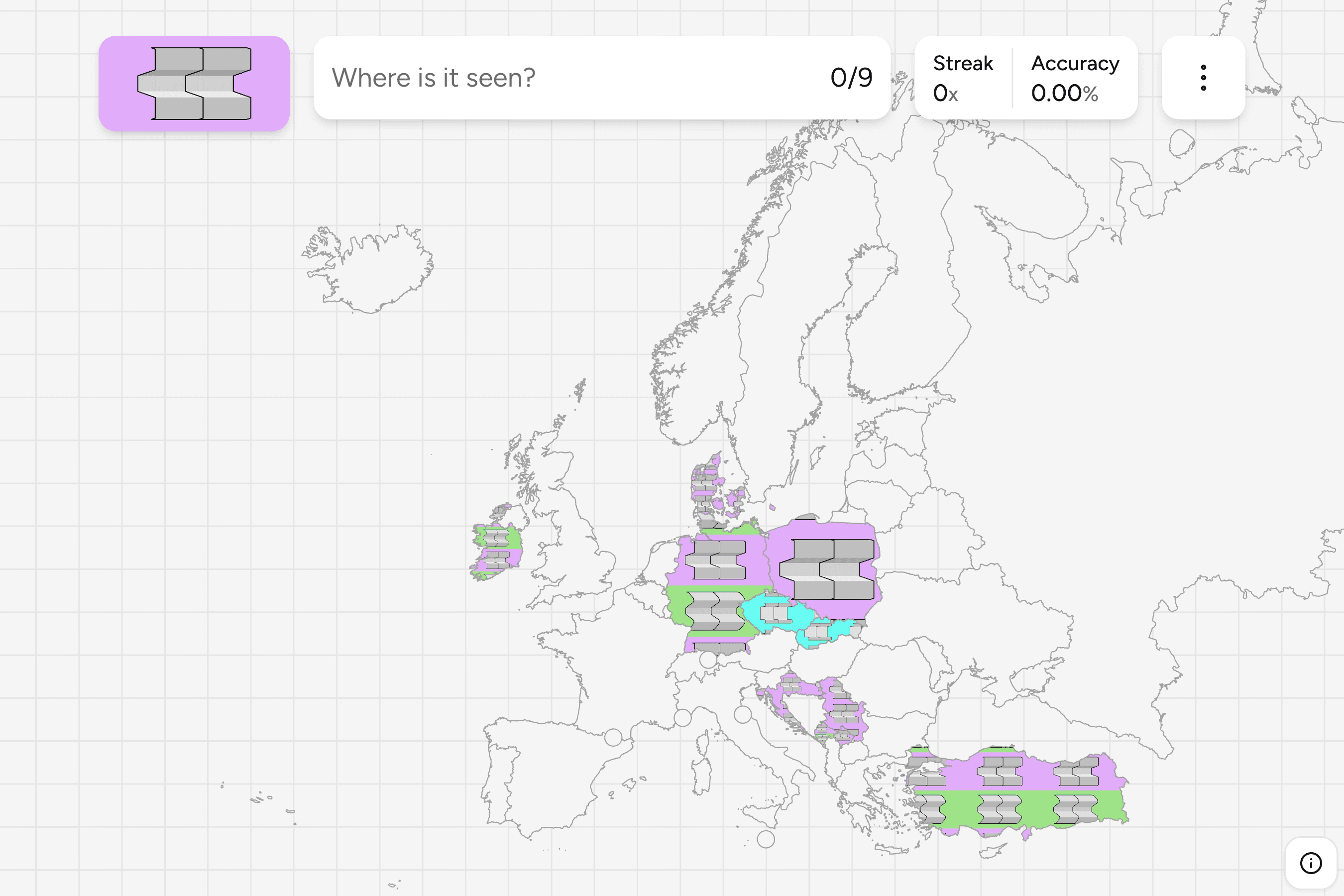
Albania, Croatia, Cyprus, Czechia, Denmark, Finland, France, Germany, Hungary, Italy, Kosovo, Latvia, Luxembourg, Malta, Monaco, Montenegro, Netherlands, North Macedonia, Norway, Moldova, Portugal, San Marino, Serbia, Romania, Slovakia, Slovenia, Spain, Turkey28 countries
Austria, Belgium, Cyprus, France, Greece, Ireland, Italy, Kosovo, Malta, Monaco, Montenegro, North Macedonia, Poland, Portugal, Serbia, Slovenia, Spain17 countries
Belarus, Estonia, Ireland, Lithuania, Russia, Ukraine6 countries
Bulgaria, Hungary, Iceland, Norway, Sweden5 countries
Andorra, Spain2 countries
Czechia, Denmark2 countries
Ireland, United Kingdom2 countries
Liechtenstein, Switzerland2 countries
Spain1 country
Countries that use more than one
These are the countries where the count alone will catch you out: an older sign
still standing beside its replacement, or a second design in service on a
different class of road. The game asks about all of them, so a round in one of
these countries can be answered by more than one picture.
Cyprus
Czechia
Denmark
France
Hungary
Ireland
Italy
Kosovo
Malta
Monaco
Montenegro
North Macedonia
Norway
Portugal
Serbia
Slovenia
Spain
Worked examples
Five stripes, the defaultAlbania, Croatia, Cyprus, Czechia, Denmark, Finland, and 22 more
More than half the countries in the game, which makes this the count that
tells you least. Recognising it is still worth something: it is what rules out
everything below, so see five and stop looking at signs.
Three stripes, a tight groupBelarus, Estonia, Ireland, Lithuania, Russia, Ukraine
A short count and a coherent set, which is the pair you want. Three stripes
narrows a round to a handful of countries in one look, and the alphabet on the
next sign along separates them.
Twelve stripes, a full crossingSpain
Far too many to be anything else, and at that point you are not counting so
much as noticing that the crossing is drawn as a solid band of stripes. The
only single-country answer in the game.
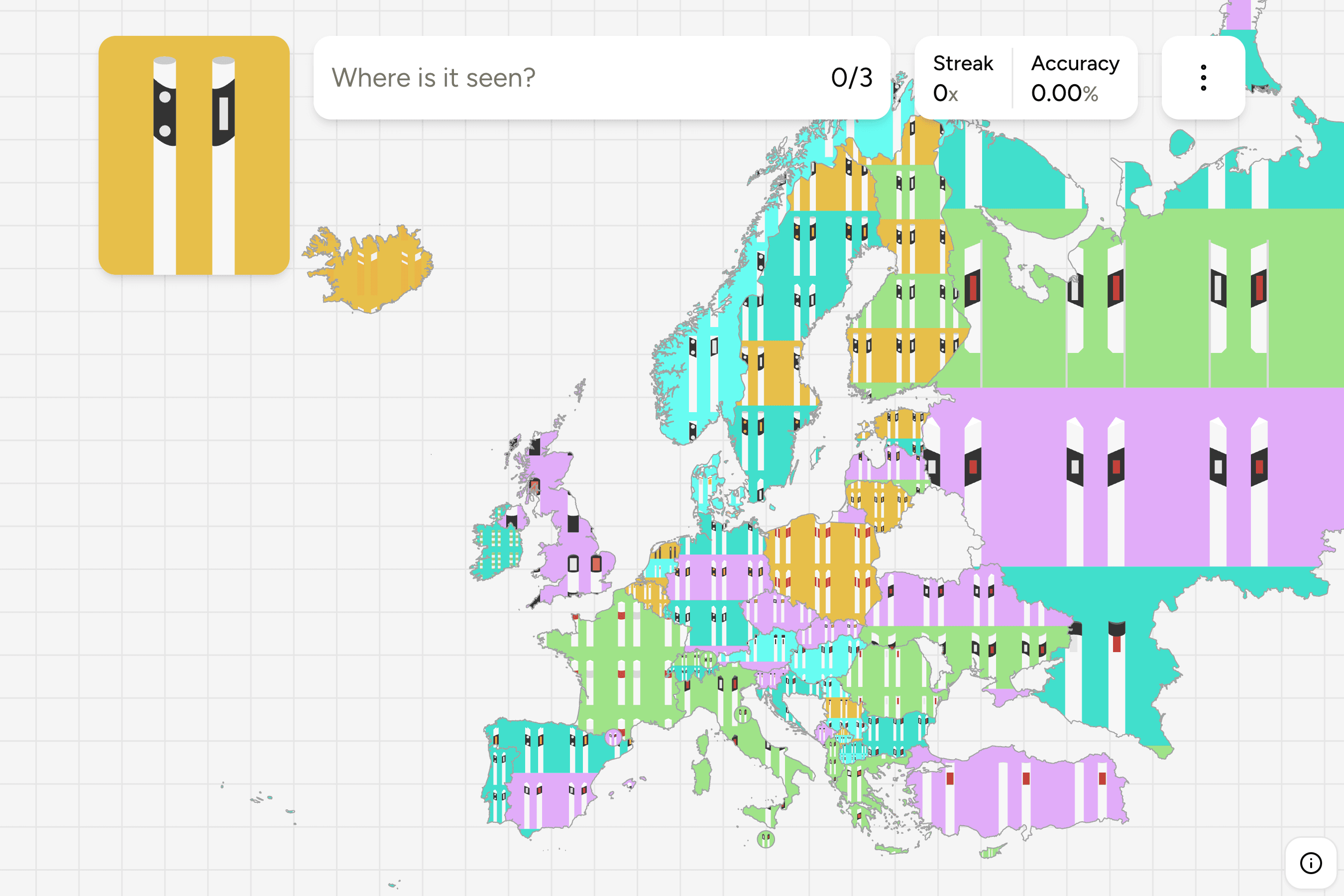
An amber globe on a striped poleIreland, United Kingdom
No sign and no stripes to count: this is the beacon standing at the end of the
crossing, and it belongs to two countries that share a border and not much
else in their signage. Once you have seen one there is nothing left to work
out.
Frequently asked questions
What is the pedestrian crossing sign meta in GeoGuessr?
It is the number of stripes drawn on the blue pedestrian crossing sign. The sign is the same shape across most of Europe and the crossing inside it is not, so counting the stripes narrows a round to the countries that use that count. The table on this page lists every count in the game against the countries that use it.
How many stripes are on a pedestrian crossing sign?
It depends on the country, which is the point. The counts in this game run from none at all up to twelve, with five by far the most common. Anything other than five is worth learning, because the rarer the count the shorter the list of countries it belongs to.
Which countries have a unique pedestrian crossing sign?
Only one count in the game belongs to a single country. Most of the rest are shared by a handful of neighbours, and the two commonest cover great swathes of the continent between them. That is why the sign is a filter rather than a final answer: read the table on this page as a shortlist generator.
Why do the United Kingdom and Ireland not have this sign?
Because they mark the crossing rather than sign it. A zebra crossing there is flanked by beacons, an amber globe on a black and white banded pole, and there is no blue square with a counted crossing on it to read. Ireland also uses signs, so it appears against more than one design in this game.
Is the stripe count enough to name the country?
Rarely on its own. Most counts are shared by several countries and a number of countries use more than one count, so the sign gives you a shortlist. Pair it with bollards, chevrons and guardrails and the list usually closes in a look or two.
How do I learn them without memorising a table?
Drill them against a map. Reading a list is recognition, and what a round needs is recall under time pressure, which is what the game on this page trains: it shows a count, you click the country, and it tells you what you missed.