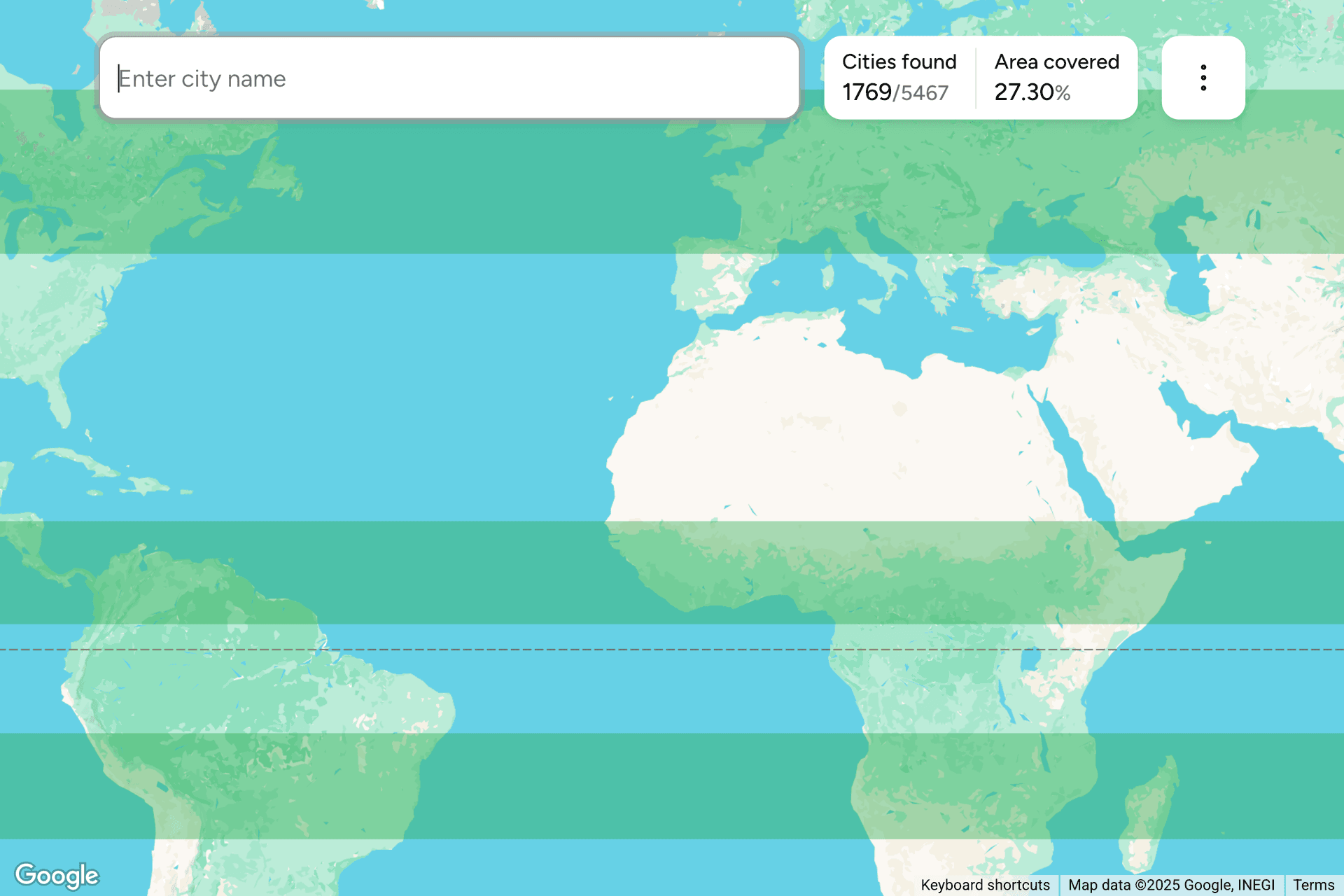
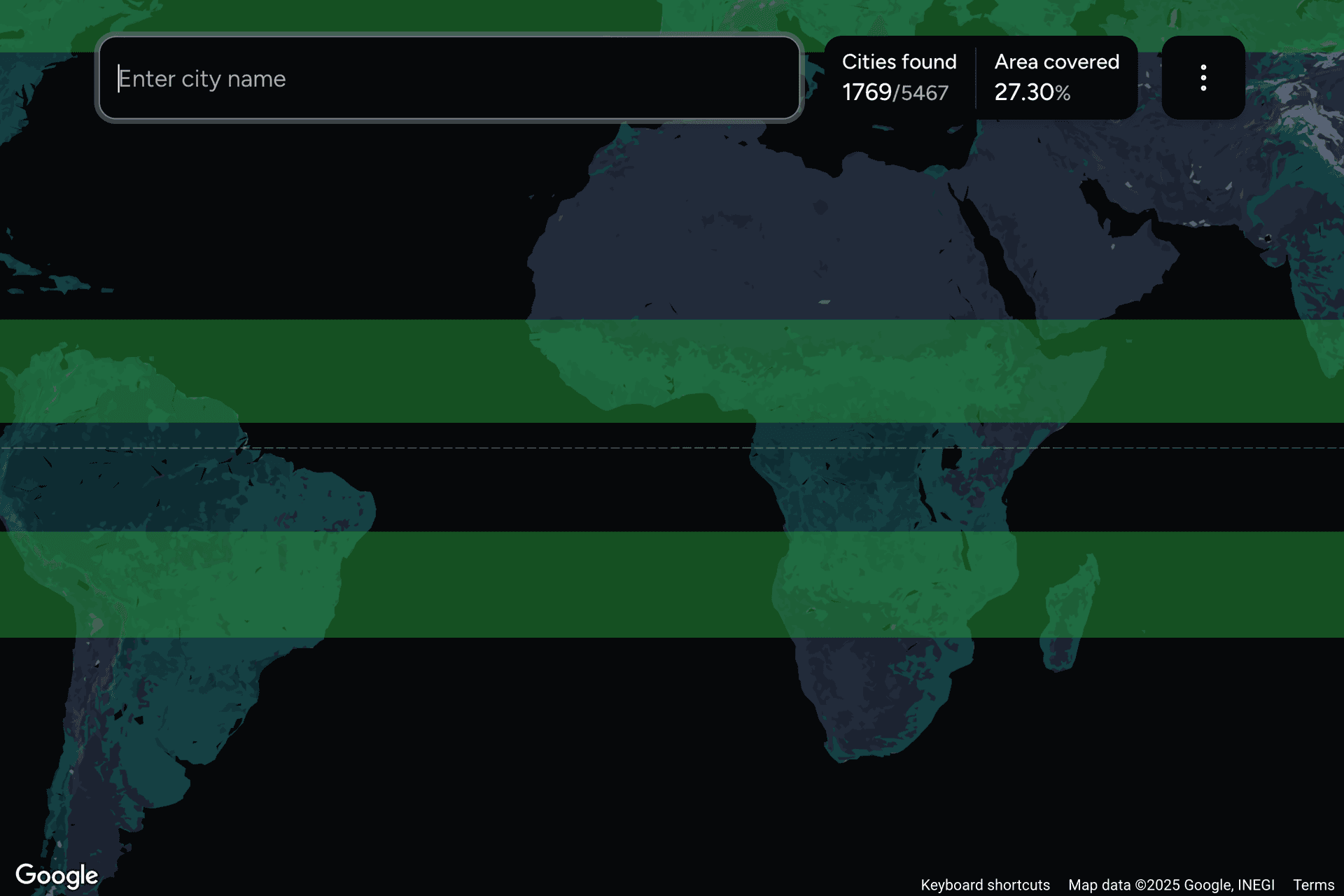
City Cover is not a quiz with questions in it. It is a text box and an empty
world map: every city you can name paints a horizontal band across the map at
that city's latitude, and the run lasts as long as you can keep thinking of
names. Nothing is timed and nothing is marked wrong, so the whole game is the
choice of which city to spend the next guess on. This page explains what the
bands are doing and how to spend those guesses so the map fills faster.
How the game works
One box, no rounds. Type into the box on the play screen. The moment what
you have typed matches a city in the list, that city is yours, a band appears
and the box clears itself. A name that matches nothing simply stays in the box,
so there is no penalty for a wrong guess and no reason not to try one.
Only latitude counts. A band runs the full width of the world, from one
edge of the map to the other, centred on the city you named. Where the city sits
east to west makes no difference at all. Quito, Nairobi, Singapore and Belém are
four very different guesses on a globe and very nearly the same guess here,
because all four sit within a couple of degrees of the equator. This is the
single fact the game turns on, and it is the one most new players take a few
runs to believe.
Bands merge. Two cities close together in latitude produce one wider band
rather than two, and a city inside a band you already own adds nothing to the
map at all. Naming Rotterdam after Amsterdam is a free city on the counter and
zero new ground.
The map has parts nothing can reach. Some latitudes have no city large
enough to be in the list: everything south of the tip of South America, and the
gaps between the thinly populated far north. Those are shaded out from the
start, and they are left out of the percentage, so the coverage figure is
measured against what is actually reachable rather than against the whole
globe. Full coverage is possible on every difficulty.
Two counters that reward opposite things. Cities found counts every city
in the list that falls inside your bands, not just the ones you typed, so it
jumps by dozens when you name somewhere on a crowded latitude. Area covered is
the one the game is about. A guess that moves the first and not the second was a
wasted guess.
Difficulty sets how tall a band is. Easy gives each city a generous band,
medium a narrower one, hard little more than a sliver. Narrower bands do two
things at once: you need many more cities to fill the map, and more of the map
becomes unreachable, because latitudes that one wide band used to bridge now
fall between two thin ones.
The run is saved in your browser. Leave the page and the cities you have
named are still there when you come back, behind the Resume button above.
Starting a new game clears them, which is also how you change difficulty.
What makes a good guess
The list holds cities of a hundred thousand people or more, and most of them are
crowded into the northern middle of the map, between roughly the tropics and the
top of Europe. That band of the world fills itself as a by-product of naming
anywhere at all. The scarce latitudes are the far north, the far south, and
whatever thin gap you have left behind you.
- Buy the latitudes nobody else sells. The top and the bottom of the map
have a handful of candidates each, and if you do not name them nothing else
will cover them. Every large city in the world sits below about 69 degrees
north, and below roughly 53 degrees south there is nothing at all.
- Step, do not cluster. After a city, the next useful guess is one band
further along, not the next city that comes to mind in the same country.
Berlin, Hamburg and Cologne are three names for one band at every
difficulty.
- Think in long thin countries. Chile, Norway, Japan, Argentina, New
Zealand, Vietnam and the length of Russia give you a ladder of latitudes
under one act of remembering, which is what you want when your memory rather
than your knowledge is the bottleneck.
- Namesakes are free. The box adds every city that matches what you typed,
so an ambiguous name is several cities for one guess. Springfield, Santa
Cruz, San José, Victoria, Córdoba, Tripoli and Alexandria all pay more than
once, and their copies are usually on different continents and different
latitudes.
- Save the middle for last. Anywhere between the Sahara and the Baltic will
still be there later, and by then a good deal of it will already be green.
The three ways a run stalls: naming capitals, which are clustered in the
temperate north for the same reasons the cities are; forgetting the southern
hemisphere, which is where most of the remaining grey usually is; and a spelling
the list does not have. Accents and capitals do not matter, so sao paulo finds
São Paulo, but a name that is genuinely different in another language will not
be found until you switch the input language in the menu on the play screen.
A worked opening
Open at the ends of the map, because those bands have almost no substitutes, and
work inwards.
- Murmansk, or Norilsk. Nothing sizeable lives further north, so this
is the roof of the map and nothing else you name will ever cover it.
- Reykjavik and Arkhangelsk for the mid sixties, then Anchorage and
Yakutsk just below them. Four names and the whole Arctic is done.
- Helsinki, Oslo or Saint Petersburg for the high fifties, then
Edinburgh and Copenhagen. This is the last northern latitude that
needs deliberate effort.
- Now jump to the far south, which is thinner than the far north and is where
most players leave the map grey. Punta Arenas is the floor. Above it,
Comodoro Rivadavia, Puerto Montt, Christchurch, Hobart,
Wellington and Bahía Blanca climb back towards the middle in
reasonable steps.
- Cape Town, Buenos Aires, Sydney, Perth and Auckland carry
you up through the thirties south, and Johannesburg, São Paulo,
Brisbane and Rio de Janeiro through the twenties.
After that the map tells you where to go: whatever is still grey is a latitude
you have not thought of yet, and the remaining work is reading the map rather
than listing cities.
Frequently asked questions
What is City Cover?
A map filling game. You name cities, and each city you name covers a horizontal band of the world map at that city's latitude. The aim is to cover as much of the map as you can. There are no rounds, no timer and no wrong answers, only the question of which city is worth the next guess.
Which cities count in City Cover?
Cities of a hundred thousand people or more, taken from the GeoNames database. Smaller towns are not in the list, so a name that does nothing is usually a place under the cutoff rather than a spelling mistake. Accents and capital letters are ignored when matching.
Does longitude matter in City Cover?
No. Only latitude does. A band runs the full width of the map, so two cities at the same distance from the equator cover the same ground however far apart they are east to west. Naming Tokyo and then Los Angeles feels like crossing an ocean and covers almost exactly the same band.
Why is part of the map greyed out in City Cover?
Because no city in the list can reach it. There is nothing large enough south of the tip of South America, nothing above the northern edge of Russia and Norway, and on the harder settings the narrow bands leave small gaps in between. Shaded latitudes are excluded from the percentage, so covering the map completely is possible on every difficulty.
How do you get to 100 percent in City Cover?
By treating the extremes as the real game. The far north takes about four names and the far south about half a dozen, and neither will ever be covered by accident. The crowded middle of the map fills itself while you do everything else, so it is the part to leave until last.
Does City Cover save my progress?
Yes, in your browser. The cities you have named survive closing the tab, and the Resume button on the game page picks the run back up. Starting a new game clears them, which is also how you switch difficulty. Nothing is stored on a server and there is no account to make.
Can I play City Cover in another language?
Yes. The menu on the play screen switches the input language between English, Dutch, Spanish, French and German, and the city list is reloaded with the names used in that language. It is the setting to reach for when a city you are sure about is not being recognised.
City Blocks is the same idea on a grid, where east and west count
as much as north and south, and it is the natural next game once the latitudes
of the world are in your head. If you would rather be tested than test yourself,
the map trainers ask a question and wait for an answer.
Sources