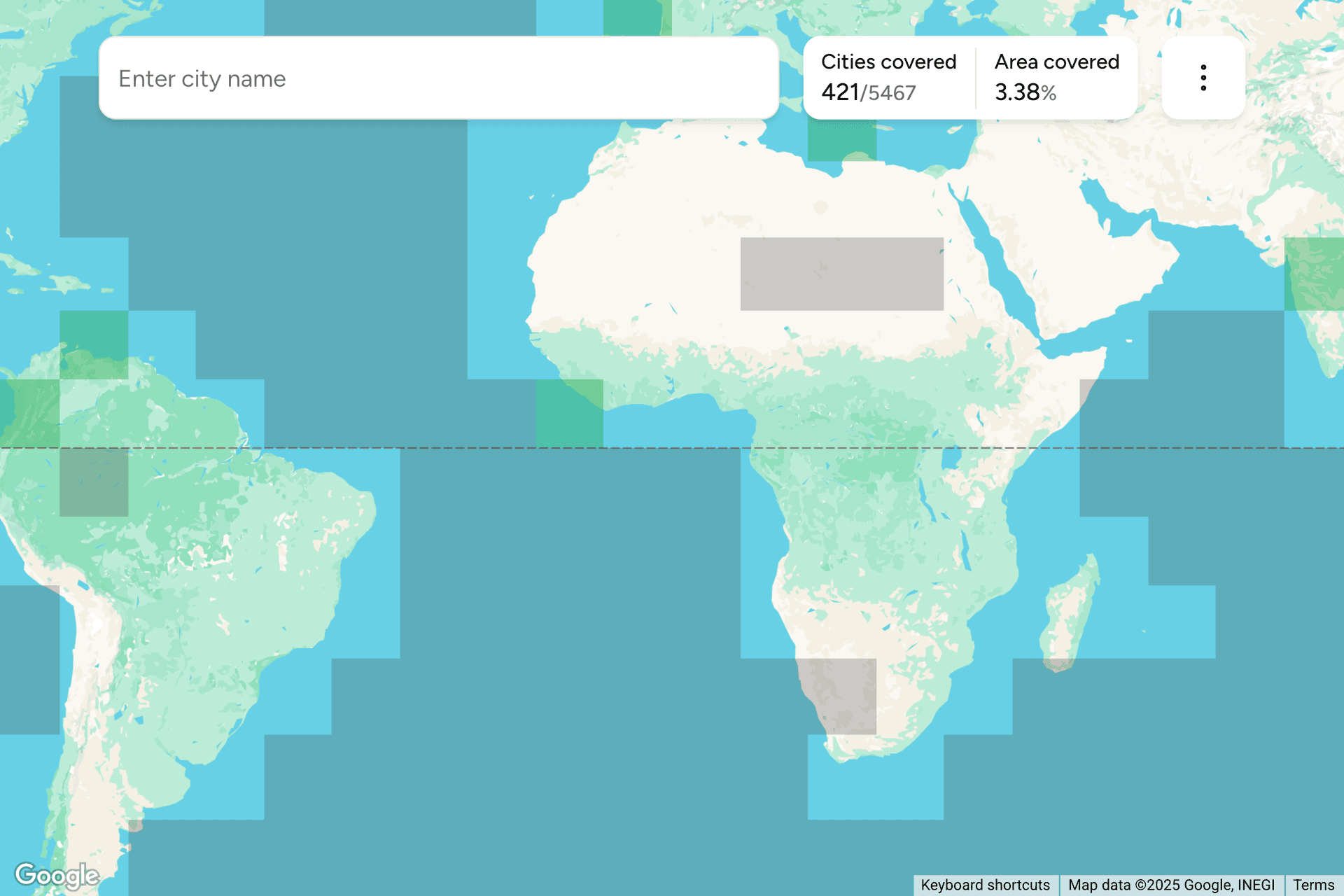
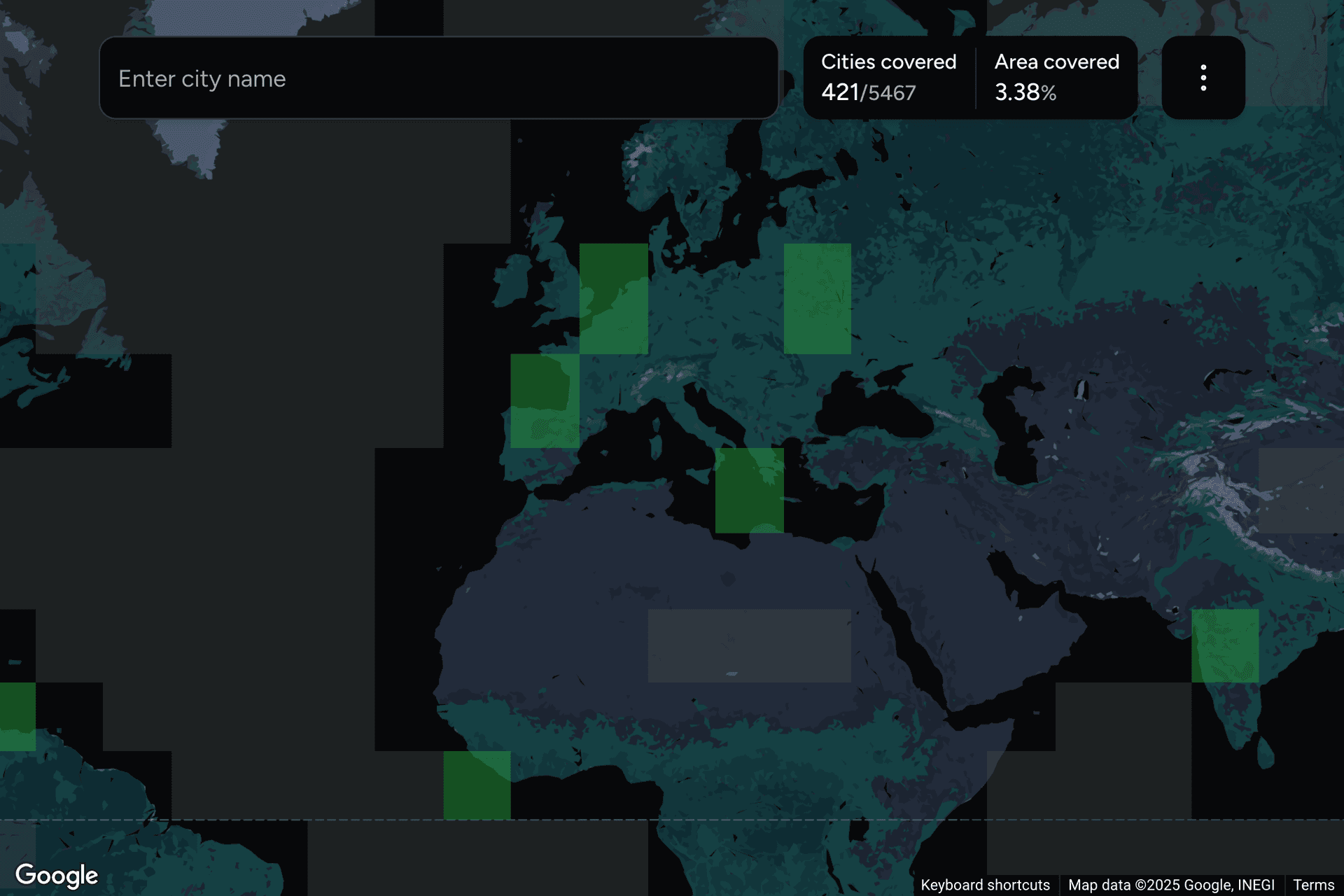
City Blocks lays a grid of squares over the world and asks you to put a city in
every one of them. Name a city and its square fills in; name a second city in
the same square and nothing happens. There is no timer, no scoring and no wrong
answer, so the whole game is knowing which cities are worth a guess. That turns
out to be a very different list from the cities you would name first, which is
what this page is about.
How the game works
One box, no rounds. Type into the box on the play screen. As soon as what
you have typed matches a city in the list, the city is yours, its square turns
green and the box clears. A name that matches nothing just sits there, so
guessing costs nothing.
The grid is fixed, and it is measured in degrees. The squares are laid out
from the equator and the prime meridian outwards, always in the same places,
whatever you name. This is the difference from
City Cover: east and west count here as much as north and south,
and two cities on the same latitude are two different guesses.
One city per square is all a square wants. A square is filled by its first
city and stays exactly as filled afterwards. Tokyo and Yokohama are the same
square at every difficulty, so the second of them is worth nothing on the map.
Squares near the poles are smaller pieces of ground. A degree of longitude
is a fraction of the distance near the Arctic that it is at the equator, so
northern cities that feel close together often sit in different squares, while
two cities the same distance apart in the tropics share one. Scandinavia,
northern Russia and Canada pay out more squares per city than anywhere else.
Empty squares are shaded out. Most of the grid is ocean, desert, ice or
mountain with no city in the list anywhere inside it, and those squares are
greyed from the start and left out of the percentage. The clear squares are the
ones some city can fill, so the map is telling you where the reachable work is
before you type anything.
Two counters that reward opposite things. Cities covered counts every city
in the list that sits in a square you have filled, so it leaps when you name
somewhere in a dense region. Area covered is the game. Naming a fourth city in
the Ruhr moves the first counter and not the second.
Difficulty sets how big a square is. Easy uses large squares, so there are
fewer of them and each is easy to reach; hard cuts them down, which multiplies
the number of squares to fill and splits apart cities that used to share one.
Amsterdam and Groningen are one square on easy and two once the grid tightens.
The run is saved in your browser. Come back later and the cities you have
named are still there, behind the Resume button above. Starting a new game
clears them, which is also how you change difficulty.
What makes a good guess
The list holds cities of a hundred thousand people or more, and they are not
spread evenly: a good share of the world's squares hold exactly one candidate
city, and a small number of squares hold hundreds. A guess is worth making in
inverse proportion to how famous the city is.
- Name the lonely ones first. Island cities, ports on an empty coast, an
oasis in the middle of a desert, the one city in a province. Each is the only
key to its square, and nothing else you type will ever open it.
- Sweep, do not cluster. Cross a wide country in steps rather than listing
its largest cities. Russia, Canada, Australia, Brazil, Kazakhstan, China and
the United States are where the squares are, and their biggest cities are
mostly bunched along one edge of the country.
- Go north for cheap squares. The same list of Norwegian, Finnish, Swedish
and Russian cities that would be one band in City Cover is a row of separate
squares here.
- Namesakes are free. The box adds every city matching what you typed, so
Springfield, Santa Cruz, San José, Victoria, Córdoba and Alexandria each pay
out several times, usually on different continents.
- Read the map, not your memory. A square that stayed clear when you
expected it to fill means you named a neighbour on the wrong side of a grid
line. The clear squares around your green ones are the cheapest guesses left,
because you already know roughly what is in them.
The way a run stalls is always the same: naming the cities that come to mind
first. Capitals and megacities cluster, and by the middle of a run each one is a
big jump in the cities counter and nothing on the map. The other stall is a
spelling the list does not carry. Accents and capitals are ignored, so
sao paulo finds São Paulo, but a genuinely different name in another language
needs the input language switched from the menu on the play screen.
A worked opening
Start with cities that have nothing near them, then sweep the wide countries.
- Honolulu, Reykjavik and Anchorage. Ocean on every side, one
square each, and nothing else in the game can reach them.
- Perth, Darwin and Townsville for the far corners of Australia,
which is the emptiest reachable country on the board.
- Cross Russia west to east: Kaliningrad, Murmansk, Yekaterinburg,
Omsk, Krasnoyarsk, Irkutsk, Yakutsk, Khabarovsk,
Vladivostok and Petropavlovsk-Kamchatsky. Ten names, ten squares, and
the longest single run of ground in the game.
- Cross Canada the same way: Halifax, Quebec, Winnipeg,
Saskatoon, Calgary and Vancouver. The territories above them stay
shaded, because nothing up there is large enough to be in the list.
- Then the interiors nobody starts with. Manaus, Belém, Cuiabá and
Porto Alegre for Brazil. Nouakchott, Bamako, Niamey,
N'Djamena and Khartoum across the Sahel. Ürümqi, Lhasa and
Almaty through central Asia.
Only after that is Europe worth typing into, and by then most of the western
half of it will already be green from a handful of names.
Frequently asked questions
What is City Blocks?
A map filling game. The world is divided into a grid of squares, and naming any city inside a square fills that square in. The aim is to fill as much of the grid as you can. There are no rounds, no timer and no wrong answers, only the choice of which city to name next.
How is City Blocks different from City Cover?
City Cover only cares about latitude: a city covers a band running the full width of the map, so where it sits east to west makes no difference. City Blocks cares about both directions, so two cities at the same latitude fill two different squares. City Cover rewards knowing the extremes of the map, City Blocks rewards knowing the empty middles of continents.
Which cities count in City Blocks?
Cities of a hundred thousand people or more, taken from the GeoNames database. Smaller towns are not in the list, which is why the far north of Canada and the far south of Argentina stay shaded however hard you try. Accents and capital letters are ignored when matching.
Why did my guess not fill a new square?
Because the city landed in a square you had already filled. A square is complete as soon as one city in it is named, so a second city in the same region adds to the cities counter and nothing to the map. Tokyo and Yokohama share a square at every difficulty, and on the easier settings so do most cities within a few hundred kilometres of each other.
Why are large parts of the map shaded out?
Because no city in the list falls inside them. Oceans, deserts, ice and high mountains take up most of the grid, and those squares are shaded from the start and excluded from the percentage. Only the squares that some city can fill are counted, so covering the map completely is possible on every difficulty.
Does the difficulty change how many squares there are?
Yes. Easy uses large squares, so there are fewer of them and each one is reached by more cities. Harder settings cut the grid finer, which both multiplies the squares to fill and splits apart cities that shared one on easy. The same opening that fills the map on easy leaves it looking sparse on hard.
Does City Blocks save my progress?
Yes, in your browser. The cities you have named survive closing the tab, and the Resume button on the game page picks the run back up. Starting a new game clears them, which is also how you switch difficulty. Nothing is stored on a server and there is no account to make.
City Cover is the same box and the same city list read only by
latitude, and the two games teach different halves of the world map. If you would
rather be asked a question than set your own, the map trainers do the
asking.
Sources
- GeoNames, the city list, the populations, and the names in each language
- Graticule, why a square measured in degrees is a different size in each place