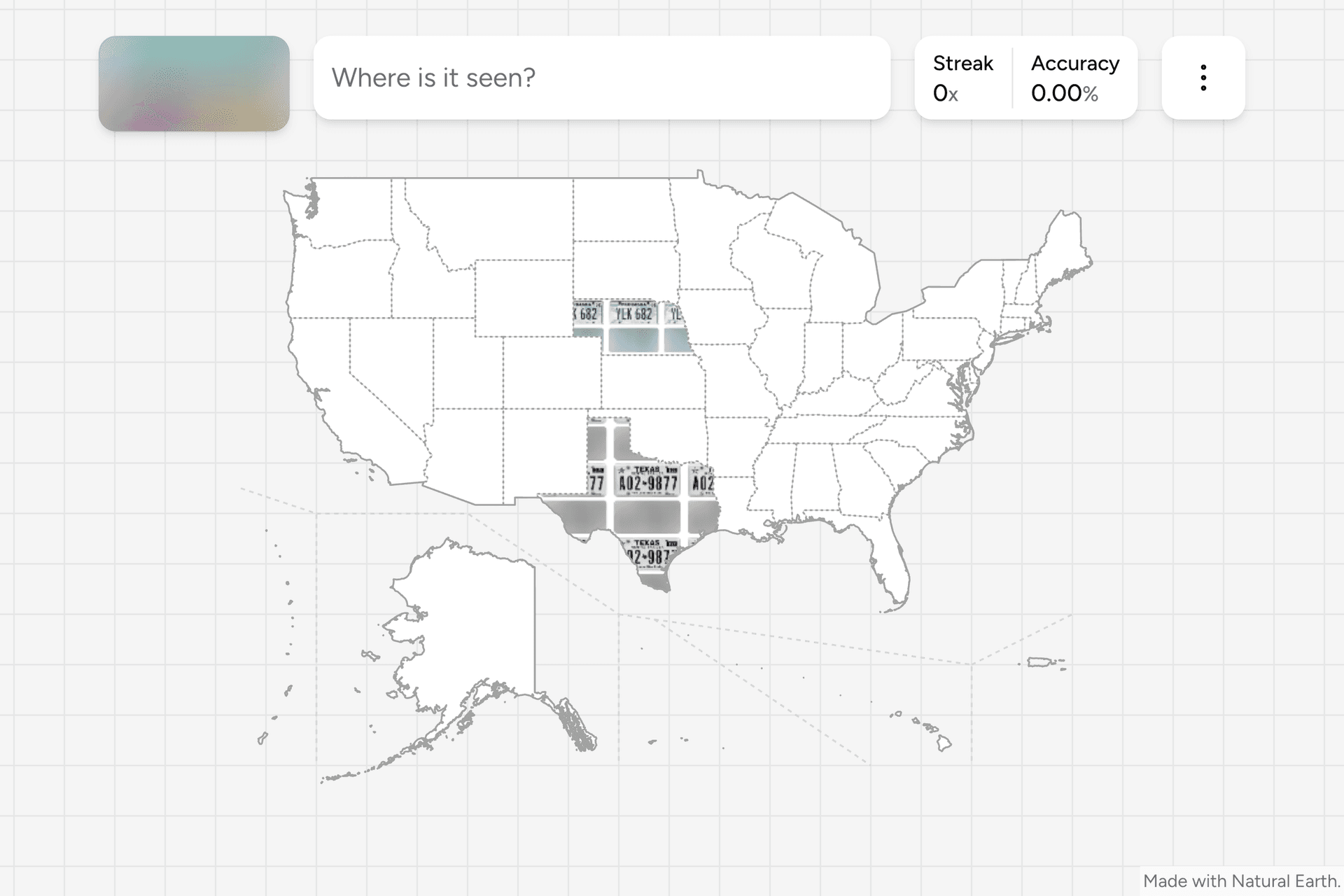
Every state issues its own license plate, and no two of them look alike. That
would be an easy clue if you could read one, but Street View blurs every plate
it drives past, so what a round actually gives you is a smear of colour the size
of a thumbnail. It turns out to be enough: the blur keeps the palette and the
layout, and those are what separate one state from the next. This page is the
full list of designs, and the game drills reading them blurred.
A license plate (a number plate, a tag) is issued by the state a car is
registered in, and the standard passenger design is chosen by that state rather
than by anybody federal. That is the whole reason this works: there is no
national plate to dilute it, so the design is a state-level fact printed on the
back of almost every vehicle in shot.
They are also stable and they are everywhere. A state runs one general-issue
design for a decade or two before replacing it, and the cars around you carry it
in car parks, driveways, at lights and on the road ahead. One design per state is
what this game asks about, which is the design you will see most often and the
one worth knowing cold.
What you will not get is a readable plate. Google blurs plates and faces
automatically, so in a round the plate is a rounded rectangle of colour and very
little else. Learning the sharp designs is still how you get there, because the
blur is the design with the detail taken out: the colours that survive are the
ones the design is mostly made of.
How to read a blurred plate
In this order, because each step throws away more of the map than the next one.
The overall colour. Most plates blur to something close to white, so a
plate that blurs to yellow, green, dark blue or black has already told you
more than all of the pale ones put together. Get the hue first and commit
to it.
Where the light and dark sit. A dark band along the top, a coloured strip
across the bottom, a gradient from one corner: the big shapes survive blurring
better than anything else, and they are what separates the pale plates from
each other.
Whether it graduates at all. A flat plate and a plate that fades from a
coloured top to a pale bottom are different answers even when the hue is the
same, and the fade survives the blur almost perfectly. Note which way it
runs.
Warm or cool, on the pale ones. This is where most rounds are actually
decided, because most plates are pale. Look past "white": they split into
blue-grey, pink-grey and green-grey, and that is usually one photograph of a
sky, a sunset or a mountain range showing through the blur.
Now the traps. Cars travel: a plate is evidence about the car, not about the
road, and near a state line the car park will be half full of the neighbours.
Specialty and vanity plates are common and they look nothing like the general
issue, older designs stay legal for years after a replacement lands, and dealer
and temporary tags are their own thing entirely. Many states issue no front
plate at all, so a car facing you may be showing you a blank. Take a plate as
a strong hint that agrees or disagrees with the rest of the round, and let the
road markings settle the argument.
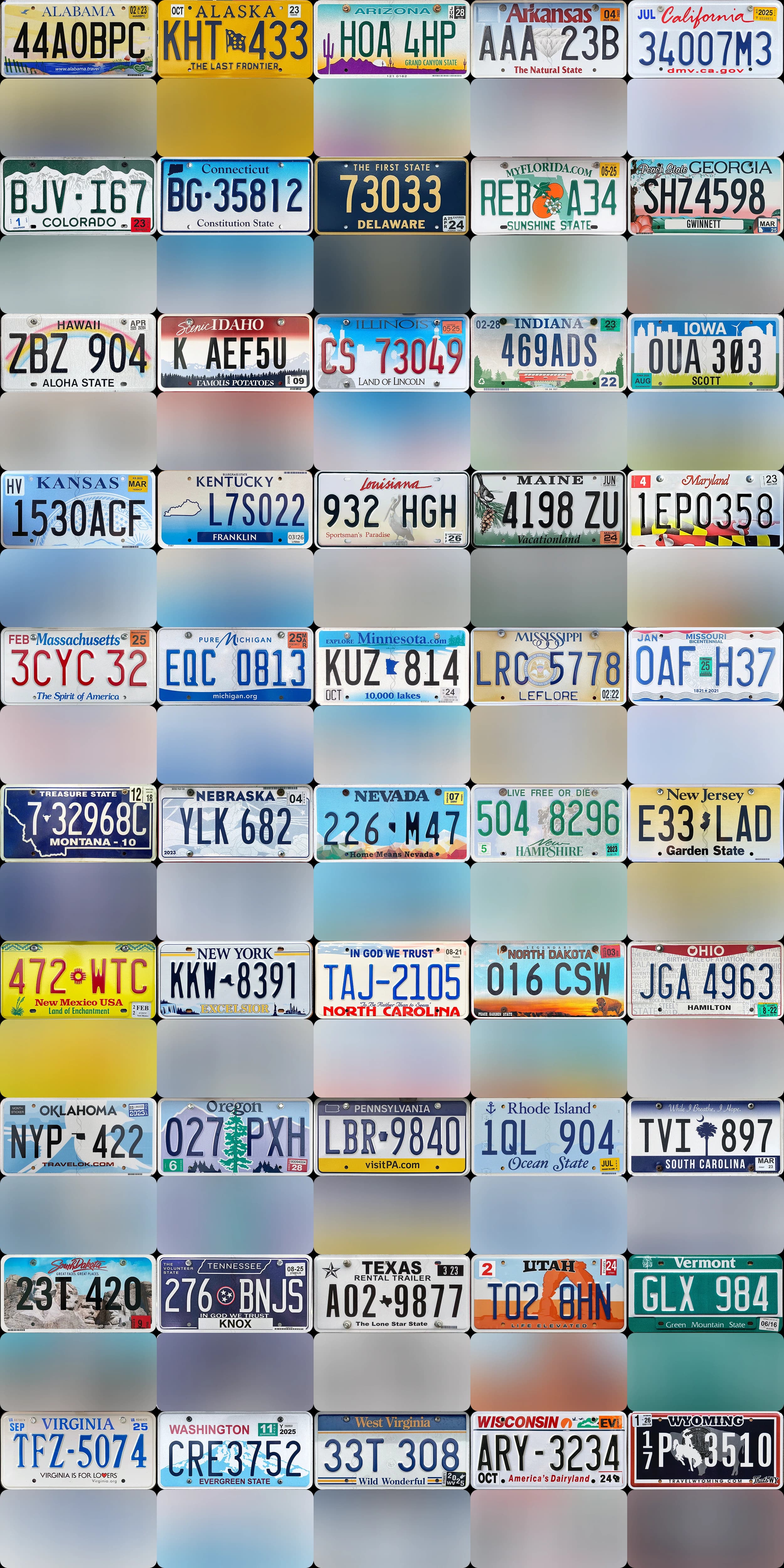
Every plate in the game
One current passenger design per state. This is the reference half of the page:
find the plate, and the state next to it is the answer.
The design the game asks about for every state. Generated from the game's own data, so it always matches what the game shows.
Plate
State
Alabama
Alaska
Arizona
Arkansas
California
Colorado
Connecticut
Delaware
Florida
Georgia
Hawaii
Idaho
Illinois
Indiana
Iowa
Kansas
Kentucky
Louisiana
Maine
Maryland
Massachusetts
Michigan
Minnesota
Mississippi
Missouri
Montana
Nebraska
Nevada
New Hampshire
New Jersey
New Mexico
New York
North Carolina
North Dakota
Ohio
Oklahoma
Oregon
Pennsylvania
Rhode Island
South Carolina
South Dakota
Tennessee
Texas
Utah
Vermont
Virginia
Washington
West Virginia
Wisconsin
Wyoming
Worked examples
These are the pictures as the game gives them to you, which is as the road gives
them to you.
Saturated yellow, edge to edgeNew Mexico
Colour this strong is doing all the work: nothing pale is in the running any
more. Check the depth of it before you commit, because a second state blurs to
a deeper gold, and the two are easy to keep apart side by side and easy to
confuse from a moving car.
Solid green, no gradientVermont
A single flat colour across the whole plate, which almost nothing else in the
country does. This is the shape of clue worth memorising: one look, one state,
no second guessing.
Dark all overDelaware
Dark plates are rare, so the darkness alone is most of the answer. The tint is
the rest of it: this one holds a cold blue-slate cast, where the only other
genuinely dark plate in the game blurs to something warmer and browner.
Near white, and that is allTexas
The plate that tells you least, and the one to recognise as such quickly. A
pale grey blur with no band, no tint and no gradient fits a long list of
states, so read it, note that it rules out everything colourful, and go and
look at something else.
Frequently asked questions
Can you use license plates in GeoGuessr?
Yes, and they are one of the better clues in the United States, but only as colour. Street View blurs every plate it photographs, so you never read the state name or the characters. What survives is the palette and the layout, and those are enough to name a lot of states on their own.
Why are license plates blurred in Street View?
Google blurs faces and license plates automatically before publishing imagery, for privacy. The blur is applied to the plate only, so the shape of the plate, its colours and the rough position of the dark and light areas all remain, which is what makes the blurred plate readable as a design rather than as a registration.
Which states have the most recognisable license plates?
The ones that are not white. A plate that blurs to a saturated yellow, a flat green or a dark background is a short list of candidates or a single state, while the pale plates need the position of a band or the tint of the characters to separate them. The table on this page is sorted by state so you can compare the pale ones against each other.
Do all states use the same license plate design?
No. Every state picks its own general-issue passenger design and replaces it every decade or two, and alongside it sells specialty plates that look nothing like the standard. This game asks about the current standard passenger design for each state, which is the one you will see most of on the road.
Does a license plate prove which state you are in?
No, it tells you where the car is registered. Cars cross state lines constantly and near a border a car park can be half out-of-state, so a single plate is a hint rather than a verdict. Several plates agreeing with each other, or one plate agreeing with the road markings and the signage, is what makes it safe to commit.
How do I learn the plates without memorising a table?
Drill them blurred against a map, which is what the game on this page does: it shows the plate the way a round shows it, you click the state, and it tells you what you missed. Reading a table teaches you to recognise a sharp plate you will never be given.
If you want another United States clue that does settle a round on its own, the
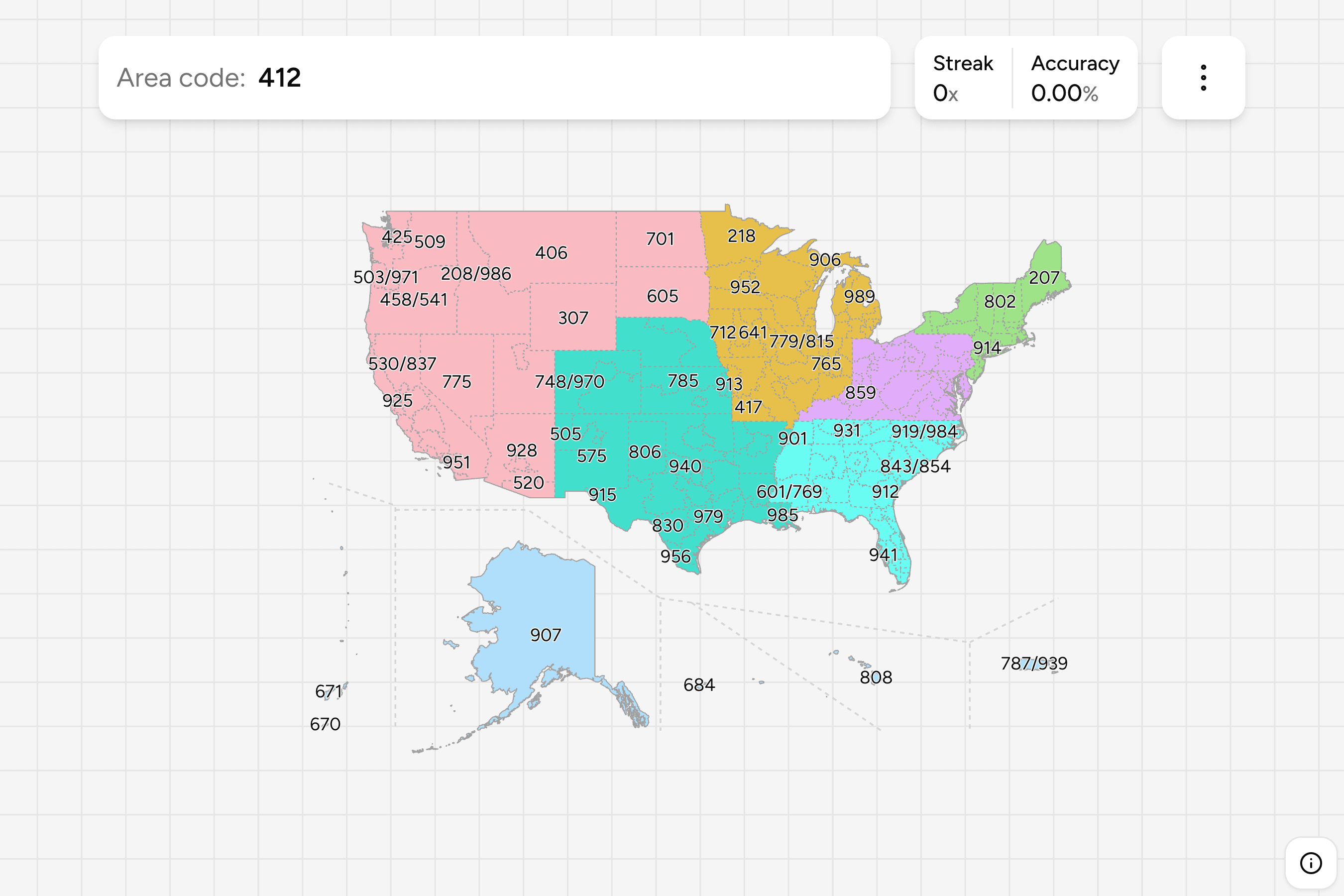
area codes on the side of a van are one: US Dialing
Codes. The European roadside trainers work the same way as
this one: European Bollards and European
Chevrons.